C/C++ Interview Questions
Q) Structure and Dynamic Memory
In C, you can define a structure and allocate memory using malloc:
struct Node {
    int data;
    struct Node* next;
};

struct Node* n1 = (struct Node*)malloc(sizeof(struct Node));
n1->data = 1;
n1->next = NULL;
In C++, it's more common to use a class with a constructor for initialization and the new keyword for dynamic allocation:
class Node
{
public:
    int data;
    Node* next;

    // Constructor
    Node(int data, Node *next)
    {
        this->data = data;
        this->next = next;
    }
};

Node *n1 = new Node(1, NULL);
Q) Dynamic Memory Allocation
To dynamically allocate an array of 10 integers in C, you can use malloc.
Q) malloc()
- The
malloc()function allocates memory during program execution. - It does not initialize the allocated memory; the memory contains garbage values.
Q) calloc()
- The
calloc()function is similar tomalloc(), but it initializes the allocated memory to zero.
Q) What is the use of a static variable in C?
- A static variable retains its value between multiple function calls.
- Its scope is available throughout the entire program.
- If not explicitly initialized, a static variable is automatically initialized to zero.
Q) What is a pointer in C?
A pointer is a variable that stores the memory address of another variable.
Q) NULL Pointer in C
- A NULL pointer is a pointer that does not point to any memory address.
- Assigning a
0value or theNULLmacro to a pointer makes it a NULL pointer.
Q) Far Pointer in C
- A far pointer is a 32-bit pointer that can access memory outside the default memory segment.
- It was primarily used in 16-bit segmented memory architectures (like MS-DOS) to access the entire 1MB of addressable memory.
Q) What is Dangling Pointer in C++
- A dangling pointer points to a memory location that has already been deallocated (freed).
- This occurs when
free()is called on a block of memory, but the pointer that was pointing to it is not set toNULL.
int *ptr = malloc(sizeof(int)); // Allocate memory
free(ptr);                     // Deallocate memory, ptr is now a dangling pointer
ptr = NULL;                    // ptr is no longer a dangling pointer
Q) Polymorphism in C++
Polymorphism means "many forms." It allows objects to behave differently in different situations.
- Compile-Time Polymorphism: Achieved through function overloading and operator overloading. The compiler resolves which function to call at compile time.
- Runtime Polymorphism: Achieved through virtual functions and function overriding. The decision on which function to call is made at runtime.
Q) Toggling the k-th Bit of a Number
You can toggle the k-th bit of a number n using the XOR (^) operator.
return (n ^ (1 << (k - 1)));
Q) Constructor and Destructor Calling Order
For inherited classes, the order of execution is:
- Parent Constructor -> Child Constructor
- Child Destructor -> Parent Destructor
Q) Void Pointers
- A
voidpointer is a generic pointer that has no associated data type. It can hold the address of any type of variable.
void *ptr;
char *str = "Hello";

ptr = str;      // Valid: a pointer of any type can be assigned to a void pointer.
// str = ptr;   // Error: a void pointer cannot be assigned to a typed pointer directly.
str = (char*)ptr; // Valid: explicit type casting is required.
Q) Abstract Class in C++
- An abstract class is a class that has at least one pure virtual function.
- A pure virtual function is a virtual function with no definition, declared by assigning
= 0. - You cannot create an object of an abstract class.
- Derived classes must provide an implementation for all pure virtual functions of the base class.
Q) Data Abstraction in C++
Data abstraction refers to the concept of hiding complex implementation details and showing only the essential features of the object. It helps in managing complexity by separating the interface from the implementation.
Q) C++ Friend Function
A friend function of a class is a non-member function that is granted access to the private and protected members of that class.
Syntax:
Example:
#include <iostream>

class Box
{
private:
    int length;
public:
    Box(): length(0) { }
    friend int printLength(Box b); // Friend function declaration
};

// Friend function definition
int printLength(Box b)
{
   b.length += 10; // Can access private member 'length'
   return b.length;
}

int main()
{
    Box b;
    std::cout << "Length of box: " << printLength(b) << std::endl;
    return 0;
}
Q) Inheritance
Inheritance is a mechanism where a new class (derived class) inherits properties and behaviors from an existing class (base class).
class Account { /* ... */ };

// Programmer class inherits publicly from Account
class Programmer : public Account {
public:
    float bonus = 5000;
};
Q) Copy Constructor
- A copy constructor is a special constructor that initializes a new object as a copy of an existing object.
- Syntax:
ClassName(const ClassName &old_object);
Example:
#include <iostream>
using namespace std;

class A
{
public:
    int x;
    // Parameterized constructor
    A(int a)
    {
        x = a;
    }
    // Copy constructor
    A(const A &i)
    {
        x = i.x;
    }
};

int main()
{
    A a1(20);      // Calls parameterized constructor
    A a2(a1);      // Calls copy constructor
    cout << a2.x;  // Outputs 20
    return 0;
}
Q) Fixing Memory Leaks
To prevent memory leaks, you must delete any memory that you allocate with new. It is also good practice to set the pointer to NULL after deleting it to avoid creating a dangling pointer.
Person* p3 = new Person();
p3->printFunc();

// Proper cleanup
if (p3 != NULL)
{
    delete p3;
    p3 = NULL;
}
Q) Storage Classes in C :
C language uses 4 storage classes, namely:
| Storage Specifier | Storage | Initial value | Scope | Life |
|---|---|---|---|---|
| auto | stack | Garbage | Within block | End of block |
| extern | Data segment | Zero | global Multiple files | Till end of program |
| static | Data segment | Zero | Within block | Till end of program |
| register | CPU Register | Garbage | Within block | End of block |
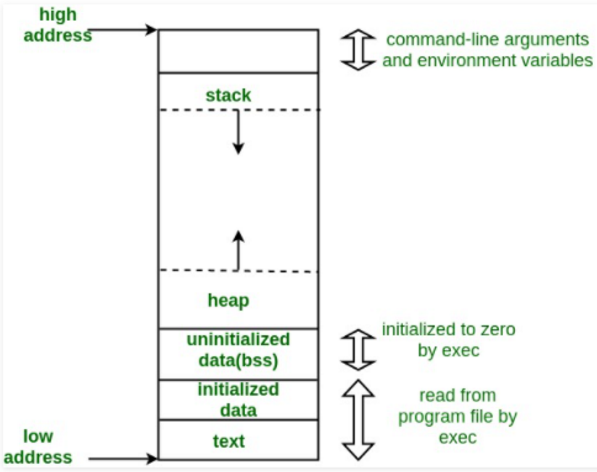
Q) Memory Layout of C Programs :
A typical memory representation of a C program consists of the following sections:
- Text segment (i.e. instructions)
- Initialized data segment
- Uninitialized data segment (bss)
- Heap
- Stack
Q) Example of Passing by Pointer:
// C++ program to swap two numbers using pass by pointer

#include <iostream>
using namespace std;

void swap(int *x, int *y)
{
    int z = *x;
    *x = *y;
    *y = z;
}

// Driver Code
int main()
{
    int a = 45, b = 35;
    cout << "Before Swap\n";
    cout << "a = " << a << " b = " << b << "\n";

    swap(&a, &b);

    cout << "After Swap with pass by pointer\n";
    cout << "a = " << a << " b = " << b << "\n";
}
Q) Example of Passing by Reference:
// C++ program to swap two numbers using pass by reference
#include <iostream>
using namespace std;

void swap(int& x, int& y)
{
    int z = x;
    x = y;
    y = z;
}

int main()
{
    int a = 45, b = 35;
    cout << "Before Swap\n";
    cout << "a = " << a << " b = " << b << "\n";

    swap(a, b);

    cout << "After Swap with pass by reference\n";
    cout << "a = " << a << " b = " << b << "\n";
}
Q) Difference between malloc() and calloc()?
| Feature | calloc() |
malloc() |
|---|---|---|
| Description | Allocates multiple blocks of requested memory. | Allocates a single block of requested memory. |
| Initialization | Initializes the content of the memory to zero. | Does not initialize the content of memory, so it contains garbage values. |
| Number of arguments | It consists of two arguments. | It consists of only one argument. |
| Return value | It returns a pointer pointing to the allocated memory. | It returns a pointer pointing to the allocated memory. |
Q) Polymorphism
- Polymorphism
- Compile Time
- Method Overloading
- Operator Overloading
- Run Time
- Virtual Function
- Function Overriding
- Compile Time
Q) Compare compile time polymorphism and Runtime polymorphism
| Feature | Compile-time polymorphism | Run time polymorphism |
|---|---|---|
| Resolution | The call is resolved by the compiler at compile time. | The call is resolved at run time. |
| Execution Speed | Provides fast execution as the method is known beforehand. | Provides slower execution as the method is identified during runtime. |
| Achieved By | Function overloading and operator overloading. | Virtual functions and pointers. |
Compile-time Polymorphism: Function Overloading
In this example, the compiler knows exactly which add() function to call based on the number of arguments provided. This decision is made at compile time.
#include <iostream>

// Two functions with the same name but different parameters
int add(int a, int b) {
    return a + b;
}

int add(int a, int b, int c) {
    return a + b + c;
}

int main() {
    // Compiler knows which add() to call
    std::cout << add(2, 3) << std::endl;      // Calls the two-argument version
    std::cout << add(2, 3, 4) << std::endl;  // Calls the three-argument version
    return 0;
}
Run-time Polymorphism: Virtual Functions
Here, the virtual keyword tells the compiler to wait until run time to decide which fun() method to call. Since the base class pointer a points to a derived class object B, the derived class's version of the function is executed.
#include <iostream>

class A {
public:
    // Virtual function
    virtual void fun() {
        std::cout << "base ";
    }
};

class B : public A {
public:
    // Overriding the virtual function
    void fun() {
        std::cout << "derived ";
    }
};

int main() {
    // Pointer of base type points to a derived class object
    A* a = new B;

    // The correct fun() is called at run time
    a->fun(); // Outputs: derived

    delete a;
    return 0;
}
Q) Inheritance :
// C++ Implementation to show that a derived class
// doesn't inherit access to private data members.
// However, it does inherit a full parent object.

class A
{
public:
    int x;
protected:
    int y;
private:
    int z;
};

class B : public A
{
    // x is public
    // y is protected
    // z is not accessible from B
};

class C : protected A
{
    // x is protected
    // y is protected
    // z is not accessible from C
};

class D : private A   // 'private' is default for classes
{
    // x is private
    // y is private
    // z is not accessible from D
};
References:
- https://www.geeksforgeeks.org/storage-classes-in-c/